Every year, hundreds of workers suffer serious injuries—or worse—during equipment servicing. The root cause? Failure to properly control hazardous energy. A lockout tagout log sheet printable is more than a piece of paper—it’s a legal safeguard, a compliance tool, and a frontline defense against preventable accidents.
OSHA’s Control of Hazardous Energy standard (29 CFR 1910.147) mandates that facilities implement a written energy control program. Central to that program is documentation—specifically, the lockout tagout log sheet. Without it, audits become risky, accountability vanishes, and safety breaks down.
This guide shows you exactly how to use, customize, and implement a printable LOTO log sheet—complete with templates, real-world applications, and common pitfalls to avoid.
What Is a Lockout Tagout Log Sheet?
A lockout tagout log sheet is a formal record that documents every instance when equipment is locked and tagged for maintenance or servicing. It captures key details such as:
- Equipment ID or name
- Date and time of lockout
- Name and ID of the authorized employee
- Type of energy sources isolated (electrical, hydraulic, pneumatic, etc.)
- Lock and tag numbers used
- Reason for lockout
- Time and signature for removal
While not every OSHA regulation explicitly requires a log sheet, documentation is a critical part of compliance. In practice, inspectors expect to see records proving that procedures were followed consistently.
Why "Printable" Matters
Printable log sheets are essential in environments where digital systems are impractical—think factory floors, remote facilities, or lockout stations in hazardous areas. A printable version ensures:
- Immediate access during emergencies
- No dependency on Wi-Fi or software
- Compatibility with physical lockout stations
- Ease of training for new staff
They’re often mounted on clipboards near machinery or stored in lockout kits.
Key Elements of an Effective LOTO Log Sheet
A well-designed lockout tagout log sheet printable isn’t just a list of fields—it’s engineered for clarity, compliance, and usability under stress. Here are the non-negotiable sections:
| Section | Purpose | Example |
|---|---|---|
| Equipment Name/ID | Identifies the exact machine | Conveyor System #4, Boiler Unit B |
| Date & Time (Lockout Start) | Establishes when isolation began | 03/15 08:15 AM |
| Authorized Employee | Assigns responsibility | John M., ID #1087 |
| Energy Sources Isolated | Lists all hazardous energy types | Electrical, Pneumatic |
| Lock/Tag Numbers | Tracks physical devices used | Lock #4512, Tag #T889 |
| Work Description | Explains the service performed | Motor replacement, sensor calibration |
| Clearance & Removal Signature | Confirms safe re-energization | Signed: John M., 10:30 AM |
Leaving any of these out weakens accountability. For example, omitting lock numbers makes it impossible to verify if a device was actually applied—or if it was removed prematurely.
Common Mistakes That Undermine LOTO Logs
Even with a printable log sheet, mistakes happen. These are the most frequent—and dangerous—errors:
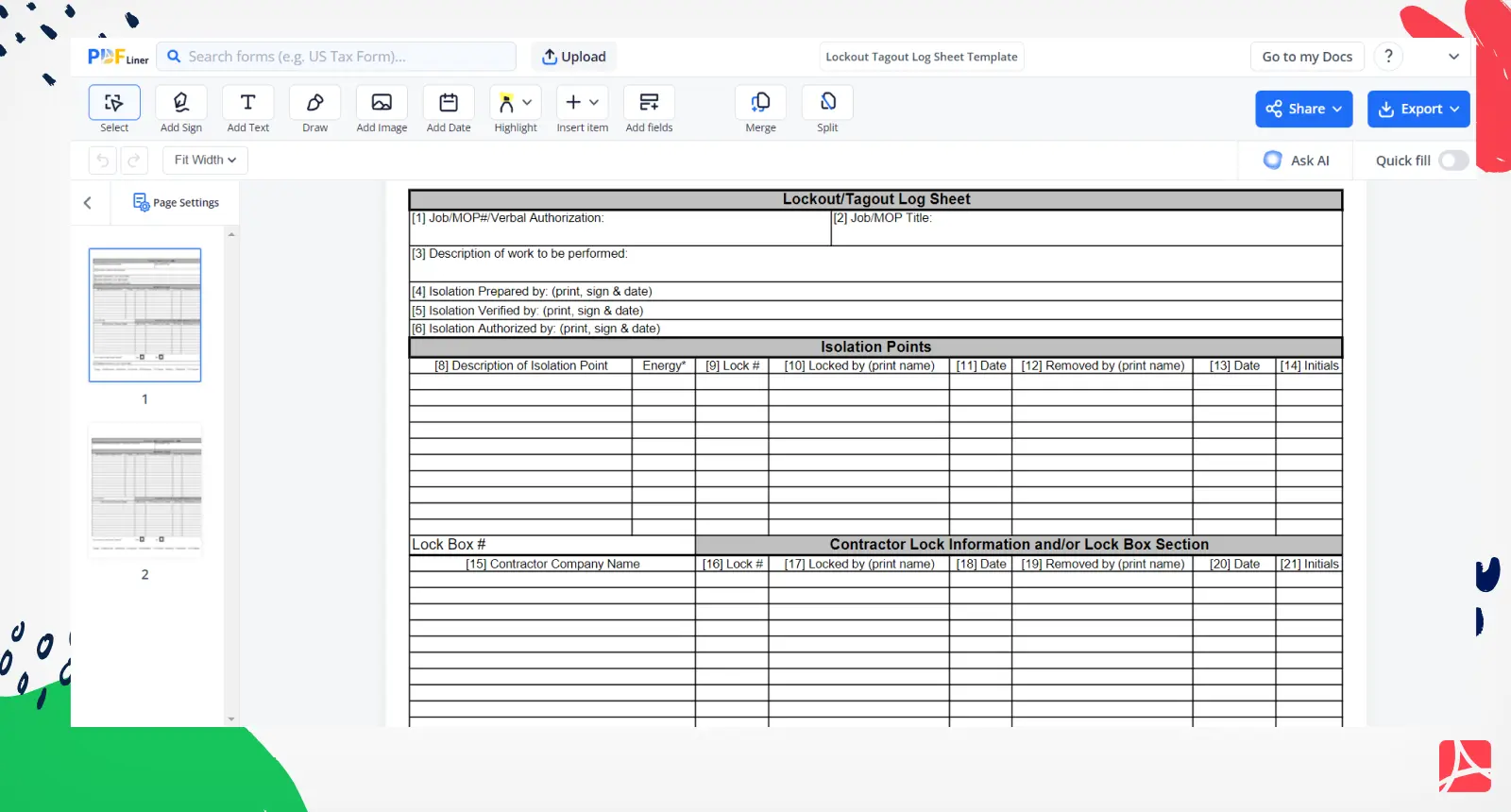
1. Blank or Incomplete Entries
A log sheet with missing fields is legally useless. In one OSHA case, a facility was fined $70,000 because logs showed partial signatures and no energy source listings.
Fix: Use bold headers and shaded sections to guide users. Never allow a lockout without a completed form.
2. Backdating or "Filling It In Later"
Employees sometimes complete log sheets after the fact—especially during rush jobs. This violates the principle of real-time documentation.
Fix: Treat the log sheet like a medical chart: record as you go. Supervisors should spot-check entries daily.
3. One-Size-Fits-All Templates
A generic log sheet used for both a 500-ton press and a conveyor belt creates confusion. High-risk equipment needs expanded fields—like secondary verification or team lockout tracking.
Fix: Customize templates by equipment class or risk level.
4. No Central Storage or Retrieval System
Paper logs stuffed in a drawer are as good as lost. OSHA may request 3–6 months of records during an inspection.
Fix: Use binders with date tabs, or scan and back up sheets weekly. Store originals for at least one year.
Printable LOTO Log Sheet Templates You Can Use Today
Below are three adaptable, printable log sheet formats—each suited for different operational needs.
Template 1: Basic Single-User LOTO Log
Best for: Small teams, routine maintenance, single-point isolation.
Features: - Clean, minimal layout - One signature line - Space for 5 energy sources
Ideal Use Case: A technician replacing a motor on a packaging machine.
Template 2: Group Lockout Master Log
Best for: Multi-craft teams working on complex systems.
Features: - Master control box tracking - Table for 8+ authorized employees - Separate clearance checklist
Ideal Use Case: Annual shutdown of a chemical processing line involving electricians, mechanics, and engineers.
Template 3: Shift-Based LOTO Tracker
Best for: 24/7 operations with rotating crews.
Features: - Shift handover section - "Pending Lockouts" warning flag - Supervisor verification field
Ideal Use Case: A night-shift maintenance crew inheriting a locked boiler from the day team.
🔹 Pro Tip: Print these on carbonless paper (NCR forms) so you keep a duplicate in a logbook. That way, the original goes with the worker, and the copy stays on file.
How to Implement a LOTO Log System in 5 Steps
Having a printable log sheet isn’t enough—you need a process.
Step 1: Audit Your Equipment List every machine requiring LOTO. Classify them by energy type and risk level. Use this to determine how many log sheet versions you need.
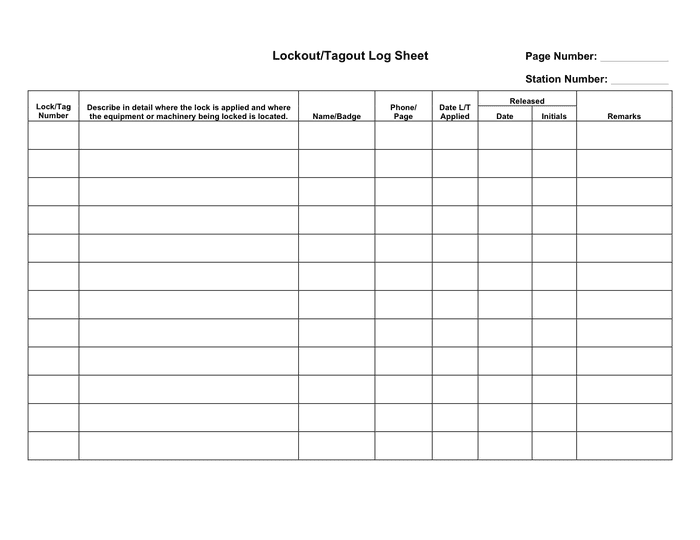
Step 2: Design or Download Templates Use tools like Microsoft Word, Excel, or Canva to create customizable forms. Or download pre-built OSHA-compliant templates from NIOSH, Grainger, or safety consortiums.
Step 3: Print and Distribute
- Print in large format (11x17") for visibility
- Laminate master copies for reuse
- Place at each LOTO station or in service kits
Step 4: Train Employees Conduct hands-on drills where workers fill out log sheets during mock lockouts. Focus on accuracy, timing, and proper storage.
Step 5: Audit Monthly Review 10% of log sheets each month. Look for: - Missing signatures - Illegible entries - Mismatched times (e.g., removal before lockout)
Document findings and retrain as needed.
Top 5 Sources for Free Printable LOTO Log Sheets
You don’t need to build a log sheet from scratch. These trusted sources offer free, downloadable, and editable templates:
- OSHA.gov
- - Official PDFs with compliance notes
- - Best for: Regulatory alignment
- - Limitation: Not highly customizable
- SafetySkills (safetyskills.com)
- - Interactive PDFs with form fields
- - Best for: Digital + print hybrid use
- - Bonus: Includes LOTO procedure guides
- Creative Safety Supply
- - Multiple formats (Excel, Word, PDF)
- - Best for: Easy editing and scaling
- - Extra: Color-coded versions for group lockout
- EHS Daily Advisor (ehsdailyadvisor.com)
- - Industry-specific templates (manufacturing, lab, HVAC)
- - Best for: Niche applications
- - Tip: Requires email signup
- Template.net
- - Highly visual, branded designs
- - Best for: Companies wanting polished internal docs
- - Note: Some are premium-only
Always verify that any downloaded template includes all required OSHA elements before deployment.
Real-World Use: How a Plant Avoided a Catastrophe
At a Midwest food processing plant, a maintenance team was repairing a grain auger. The technician applied his lock and tag—and filled out the printable log sheet at the central station.
An hour later, operations mistakenly tried to restart the line. The control room supervisor checked the LOTO log and saw: > “Auger #3 – Locked by Carlos R. (ID 204) – Electrical & Mechanical Isolation – DO NOT ENERGIZE – Work: Bearing Replacement”
They halted the start-up. Carlos was still inside the housing.
The log sheet didn’t just document compliance—it prevented a fatality. Management later credited the printable form’s visibility and mandatory sign-off as key factors.
Final Thoughts: Make Your LOTO Log a Living Document
A lockout tagout log sheet printable is not a checkbox exercise. It’s a dynamic safety tool that must be accurate, accessible, and audited. Whether you print 10 copies or 1,000, the goal is the same: ensure no machine is ever energized while someone is at risk.
Start today: download a template, customize it for your highest-risk equipment, and run a drill. Train your team to treat the log sheet with the same seriousness as the lock itself.
Because in the end, the best safety system isn’t just compliant—it’s impossible to ignore.
FAQ
What should you look for in Lockout Tagout Log Sheet Printable Guide & Templates? Focus on relevance, practical value, and how well the solution matches real user intent.
Is Lockout Tagout Log Sheet Printable Guide & Templates suitable for beginners? That depends on the workflow, but a clear step-by-step approach usually makes it easier to start.
How do you compare options around Lockout Tagout Log Sheet Printable Guide & Templates? Compare features, trust signals, limitations, pricing, and ease of implementation.
What mistakes should you avoid? Avoid generic choices, weak validation, and decisions based only on marketing claims.
What is the next best step? Shortlist the most relevant options, validate them quickly, and refine from real-world results.